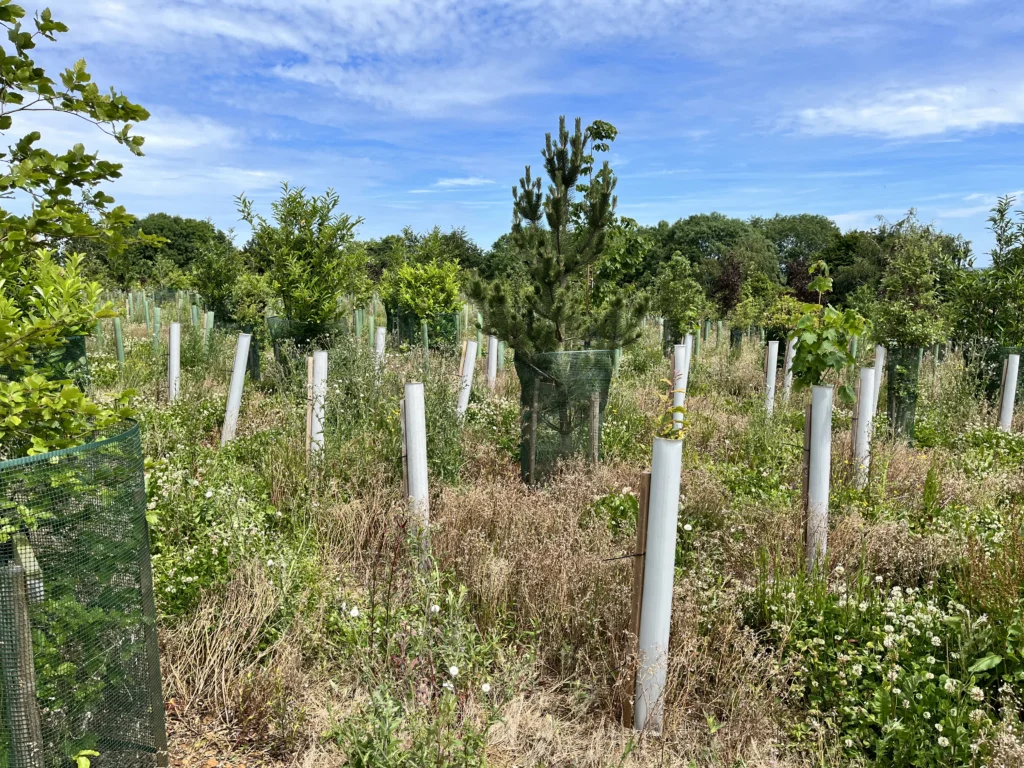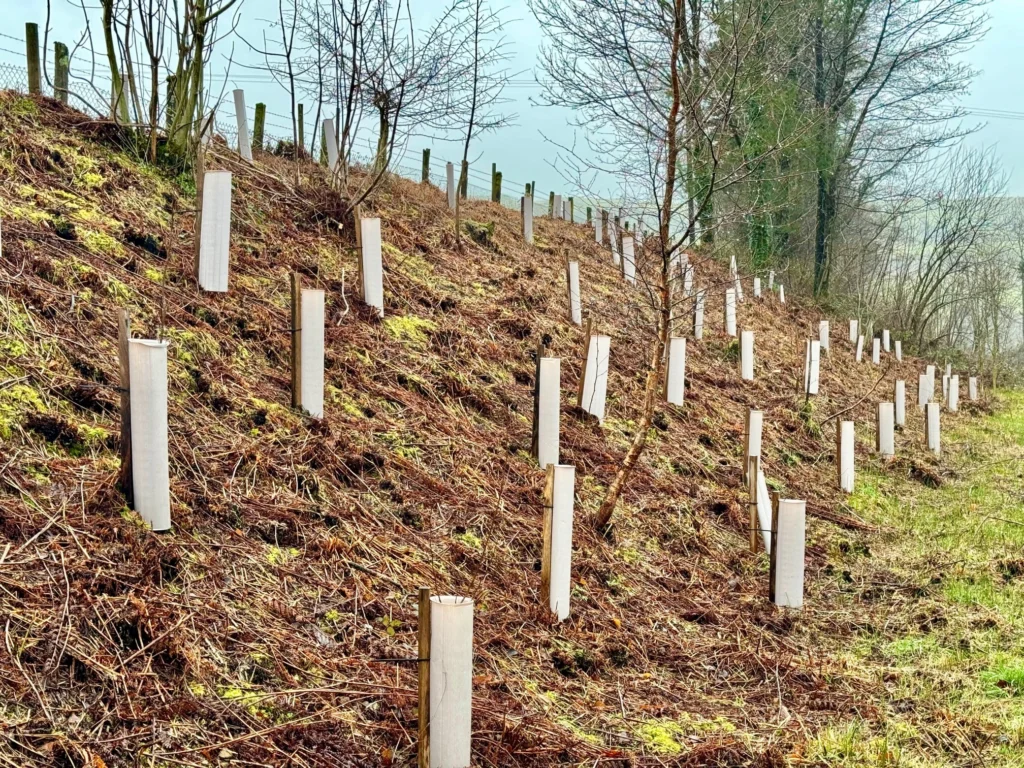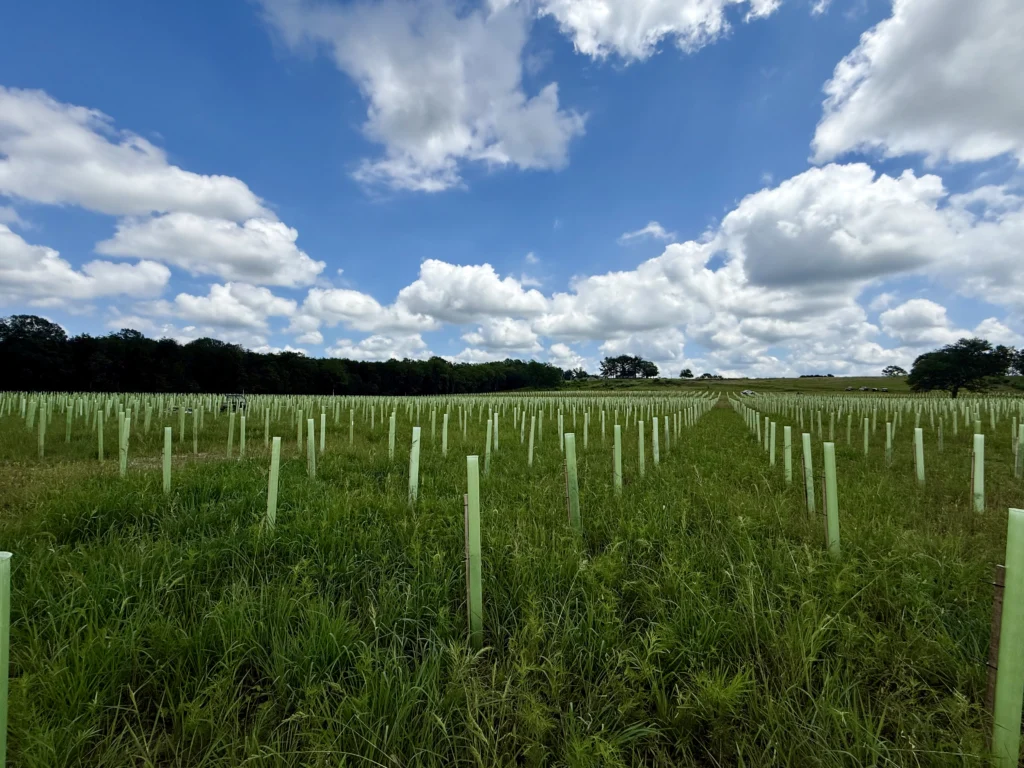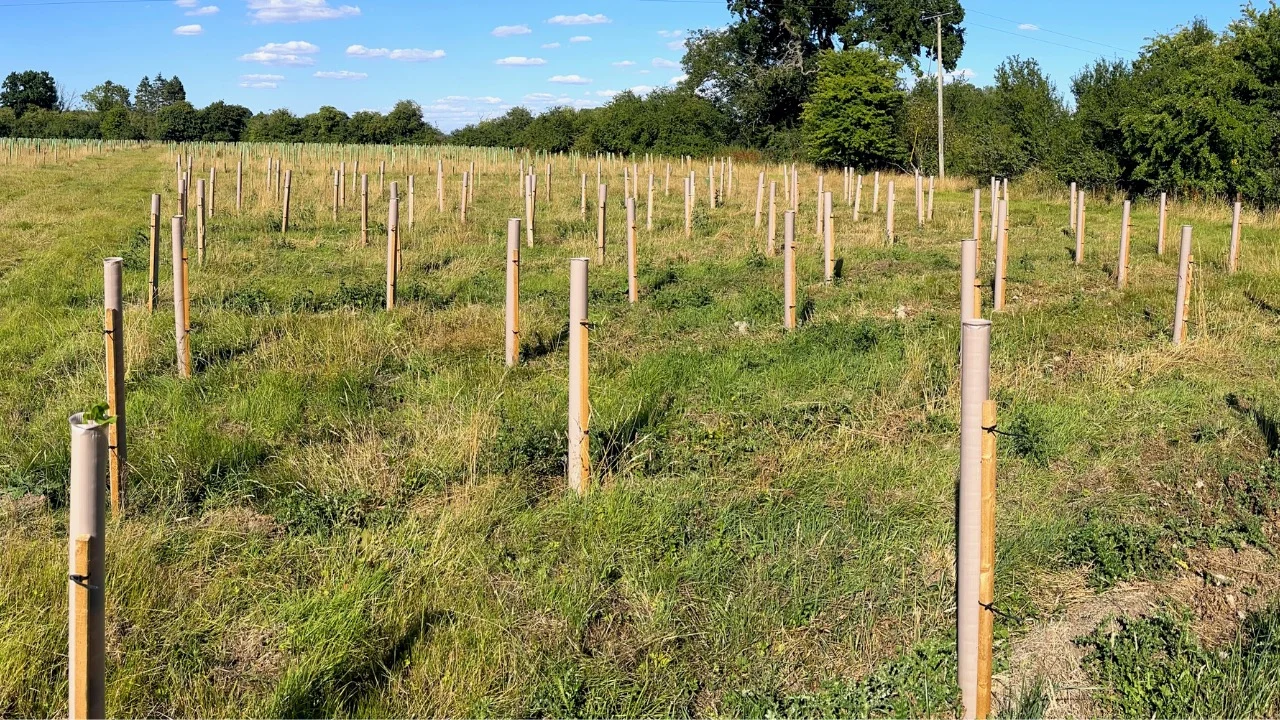
Tree shelters and carbon credits are more closely linked than most planters realise. As woodland carbon schemes mature, the materials you use to establish a planting (fencing, ground preparation and tree protection) are increasingly counted against the carbon your trees lock away. This guide explains how carbon credits work for tree planting, where tree shelters enter the calculation, and why switching to biodegradable or recyclable protection can help your project’s carbon balance rather than quietly eroding it.
How carbon credits work for tree planting
In the UK, the Woodland Carbon Code (WCC) is the government-backed standard for woodland creation projects that want to sell carbon. A validated project earns Pending Issuance Units (PIUs), a forward promise of carbon, which convert into verified Woodland Carbon Units (WCUs) as the trees actually grow and the sequestration is confirmed. Version 3.0 of the Code launched in August 2025, with projects able to use the previous version 2.2 until 30 June 2026.
To qualify, a project has to clear a set of criteria: it must be genuinely additional (the trees would not have been planted anyway), meet minimum area and stocking thresholds, demonstrate long-term permanence, and follow UK Forestry Standard practice, including a meaningful proportion of native species and open space. Crucially, the credits a scheme issues are based on net carbon: the carbon the woodland captures, minus the carbon spent creating and maintaining it.
Where tree shelters enter the carbon calculation
This is the part many planting projects overlook. Establishment is not carbon-free. Ground preparation, deer fencing and tree protection all carry a carbon cost, and the Woodland Carbon Code expects that cost to be accounted for. A site that relies on deep cultivation and large quantities of plastic tree guards and fencing will see a corresponding reduction in the net carbon, and therefore the credits, it can claim, compared with a lower-impact establishment approach.
There is a second, longer-tail issue with conventional plastic guards: what happens at the end of their working life. Standard polypropylene shelters have to be physically collected and removed once the trees are established. Across thousands of trees spread over difficult terrain, that retrieval is slow, expensive and frequently skipped, leaving fragmenting plastic in the soil. Verification under the Code happens around five years after planting and includes a check on tree protection, so abandoned guards are not just an environmental problem; they are a visible one at the exact moment your project is being assessed.
Why biodegradable and recyclable shelters help your carbon balance
Tree protection will not, on its own, make or break whether a project qualifies. The headline criteria are about additionality, permanence and design. But the protection you choose does influence the volume of credits a qualifying project earns, and how cleanly it passes verification. Lower-impact protection helps on both counts.
Soil-biodegradable shelters such as Vigilis Bio are designed to protect the tree through its establishment phase and then break down in place, removing the retrieval problem entirely: no collection trips, no leftover plastic, no awkward conversation at verification. Where guards can be gathered up easily, recyclable formats keep the material in circulation instead of in landfill. Either route reduces the plastic burden that a net-carbon calculation, and increasingly the buyers of carbon units, will scrutinise. For a fuller picture of the materials involved, see how Vigilis Bio is made.
What this means for your project
If you are planning a planting with carbon income in mind, treat tree protection as a carbon decision, not just a cost line. Specify the lowest-impact protection that will still do the job for your site and browsing pressure, and keep records of what you used. Verification will ask. Match the shelter to the species and the threat rather than over-specifying heavy plastic across the whole site, and factor end-of-life into the plan from the start.
Whether your project is commercial forestry or a rewilding scheme, the principle is the same: protect the trees properly through establishment, with materials that work with your carbon goals rather than against them. To specify protection for a carbon-funded planting, talk to your local Vigilis distributor.