Hedgerows are having a moment. After decades of removal and neglect, hedgerow restoration is now one of the most heavily supported land management activities in the UK and across Europe: backed by agri-environment funding, demanded by biodiversity targets, and increasingly specified in estate and farm plans in their own right rather than as an afterthought to woodland work. This guide covers what landowners need to know about restoring and planting hedgerows, and how to protect the young plants that the whole investment depends on.
Why hedgerows are back on the agenda
Britain lost roughly half of its hedgerows in the decades after the Second World War, and much of what survives is gappy, over-trimmed or collapsing at the base. The policy response has been substantial: hedgerow planting and management actions feature prominently in England’s environmental land management schemes, and organisations such as Hedgelink coordinate national restoration effort. The picture is similar on the continent: the bocage of northern France, the Knicks of Schleswig-Holstein and the hedge-bound pastures of Ireland and the Low Countries are all the focus of restoration programmes under the EU biodiversity strategy.
The reasons are practical as much as ecological. A healthy hedgerow is a wildlife corridor, a windbreak that shelters livestock and crops, a carbon store, and a flood-management feature that slows runoff across slopes, value that compounds for decades from a single planting season.
Planning a hedgerow restoration
Most projects fall into one of two patterns. Gapping up, replanting the missing sections of an existing but degraded hedge, and new planting on a line where a hedge once stood or is wanted for the first time. In both cases the established template is similar:
- A native, thorn-led species mix. Hawthorn and blackthorn typically form the backbone at 50–70%, with hazel, field maple, dogwood, spindle, crab apple and dog rose adding structure, blossom and berry value.
- Double staggered rows at five to six plants per metre, using bare-root whips of 40–60 cm planted in winter.
- Standard trees at intervals: oak, field maple or wild cherry left to grow through the hedge line as full-canopy trees.
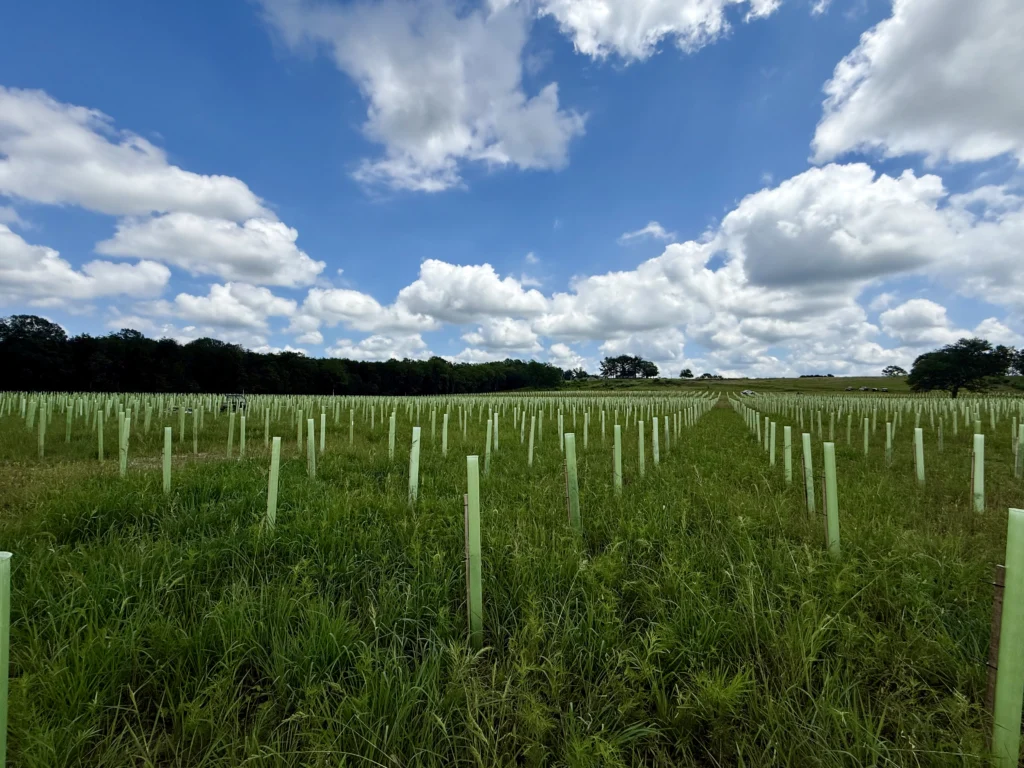
Hedgerow whips are cheap; establishment is where projects succeed or fail. A hedge planted at five plants per metre concentrates hundreds or thousands of vulnerable stems along an exposed boundary line: usually the exact line that rabbits, hares and deer already use to move through the landscape.
Why young hedge plants need protection
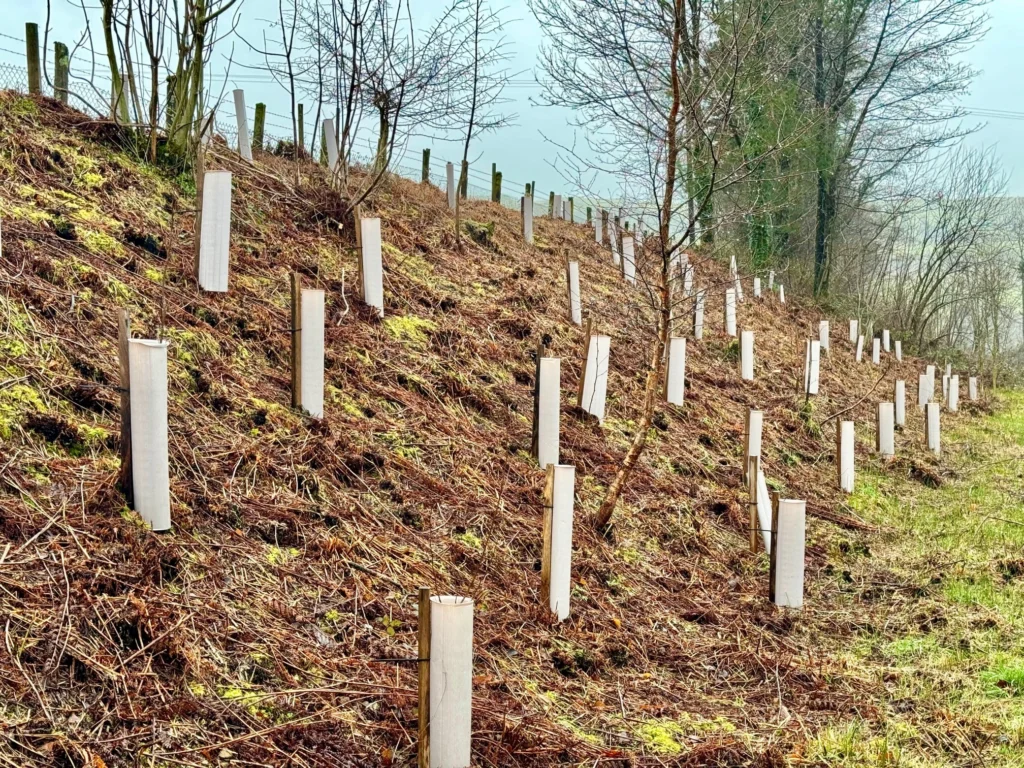
Browsing pressure on a new hedge line is relentless precisely because the hedge is a corridor: animals travel along it, not past it. Rabbits and hares take whips down to ground level; deer browse leading shoots and rub bark off anything that gets above knee height. Add spray drift from adjacent field operations and strimmer damage during weed control, and unprotected hedge planting on a live farm boundary can lose a large share of its plants before the second season.
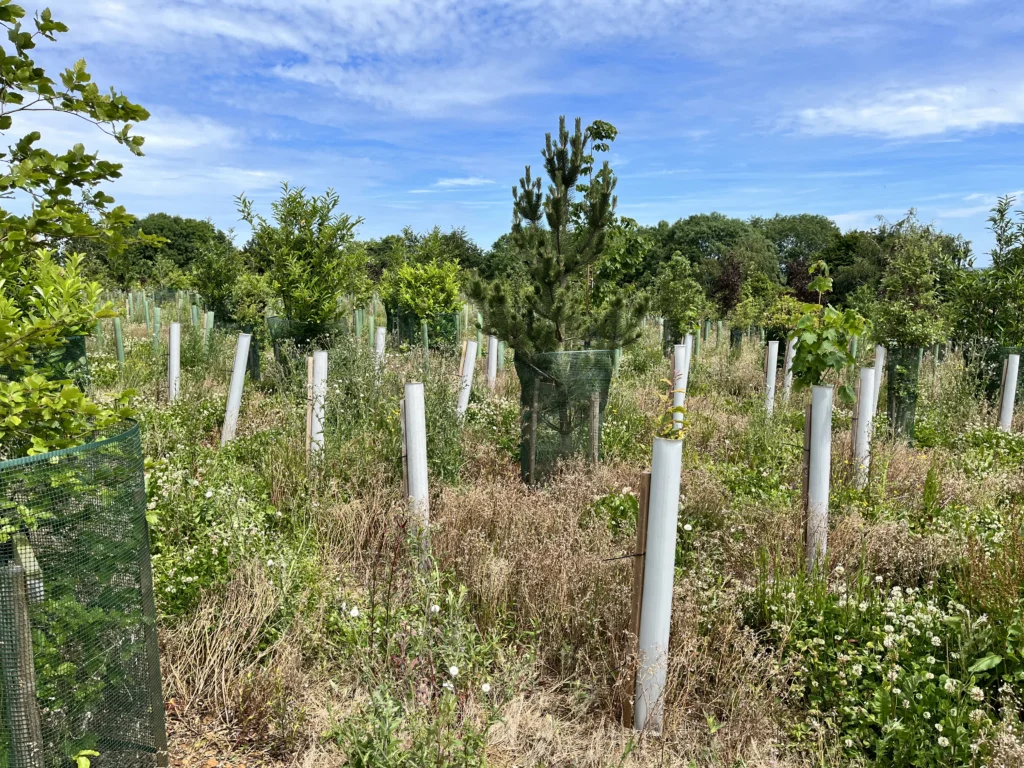
Protection also changes the growing environment. A guard around a young whip creates a sheltered microclimate that improves first-season establishment on exposed boundary lines: the same effect that drives shelter use in forestry, applied at hedge scale.
Choosing protection: hedge wraps and shrub shelters
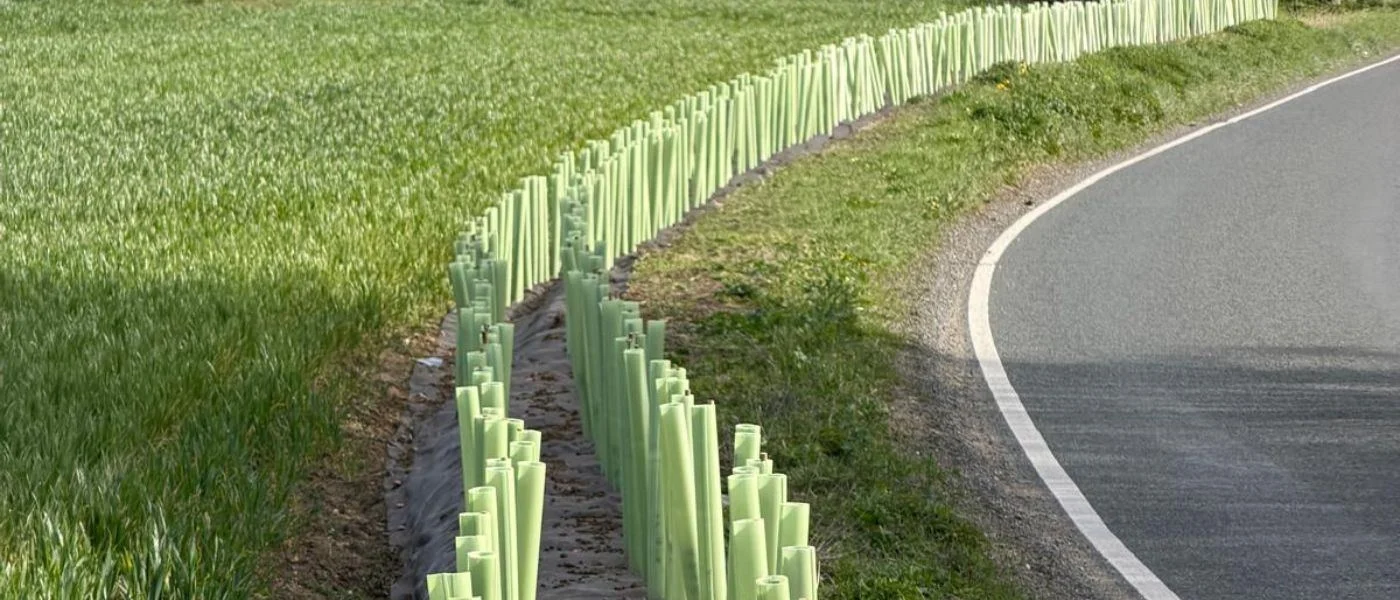
Two product families cover most hedgerow restoration work. Hedge wraps are the workhorse for the main hedge line: a guard sized for whips planted at high density, protecting the stem from browsing and spray while letting the plant breathe and branch. For the bushier, multi-stemmed species in the mix, and for the shrub component of richer restoration schemes, shrub shelters give a wider format that protects low branching rather than forcing a single leader.
Material choice deserves real thought at hedge scale. A kilometre of restored hedge can mean five or six thousand guards, and collecting them back off a thorn-filled hedge line after establishment is slow, unpleasant work that often simply doesn’t happen. That is the practical case for soil-biodegradable formats: Vigilis Bio material protects the plant through establishment and then breaks down in situ, removing the retrieval problem from the project plan entirely. Where guards can be recovered (short runs, accessible garden and parkland boundaries), recyclable formats remain a sound choice.
Aftercare and funding
Plan for two to three years of weed control at the base of the hedge, replace failures in the first winter, and leave the hedge untrimmed for the first few seasons so it can build height and density. On funding: hedgerow creation and management payments exist across UK agri-environment schemes and many European national programmes: rates and eligibility change frequently, so check the current scheme guidance for your country and region before finalising a planting specification.
For help specifying protection for a hedgerow restoration project (including mixed orders of hedge wraps, shrub shelters and tree guards for standards), see our rewilding applications page or find your local Vigilis distributor.