English vineyard planting in 2026 looks different from the boom years. The rush to put new hectares in the ground has cooled, and the work that matters now is quieter: replanting blocks that have underperformed, and gapping up rows where vines have failed. Both jobs need vine guards, and both are easy to under-specify because they are maintenance rather than establishment.
Where the English wine sector actually is
The numbers still point upward, but more gently. Vineyards registered with the Food Standards Agency now number 1,158, a 4.3% increase year on year, across roughly 4,357 hectares of active vines. More than 10,000 people work in the sector. Growth of that shape, more holdings and steadily expanding area, means a large share of the national vineyard is now old enough to need remedial work rather than first planting.
The 2026 season sharpened the point. After the driest and sunniest July on record for England and Wales, a handful of producers began picking in late August and most were underway by mid-September, the earliest English vintage on record. WineGB reported healthy vineyards, clean fruit and good ripening, but the season also delivered frost, hail and a heatwave. Vineyards that came through with gaps in the rows know exactly where their weak blocks are.
Why gapping up is harder than planting
Replacing a dead vine in an established row is not the same job as planting a new block, and the difference works against the young plant. A replacement vine goes into ground already occupied by mature root systems competing for water and nutrients. It sits under a canopy that shades it. It is surrounded by vines two, five or ten years older, which means every pass of the sprayer, mower and trimmer is calibrated for mature plants rather than for a whip.
That last point causes most of the avoidable losses. Herbicide drift and strimmer damage kill more replacement vines than browsing does, because machinery operators cannot always see a small plant in an otherwise uniform row. A guard makes the vine visible and gives it a physical barrier at exactly the height where damage happens.
What a vine guard has to do on a replant
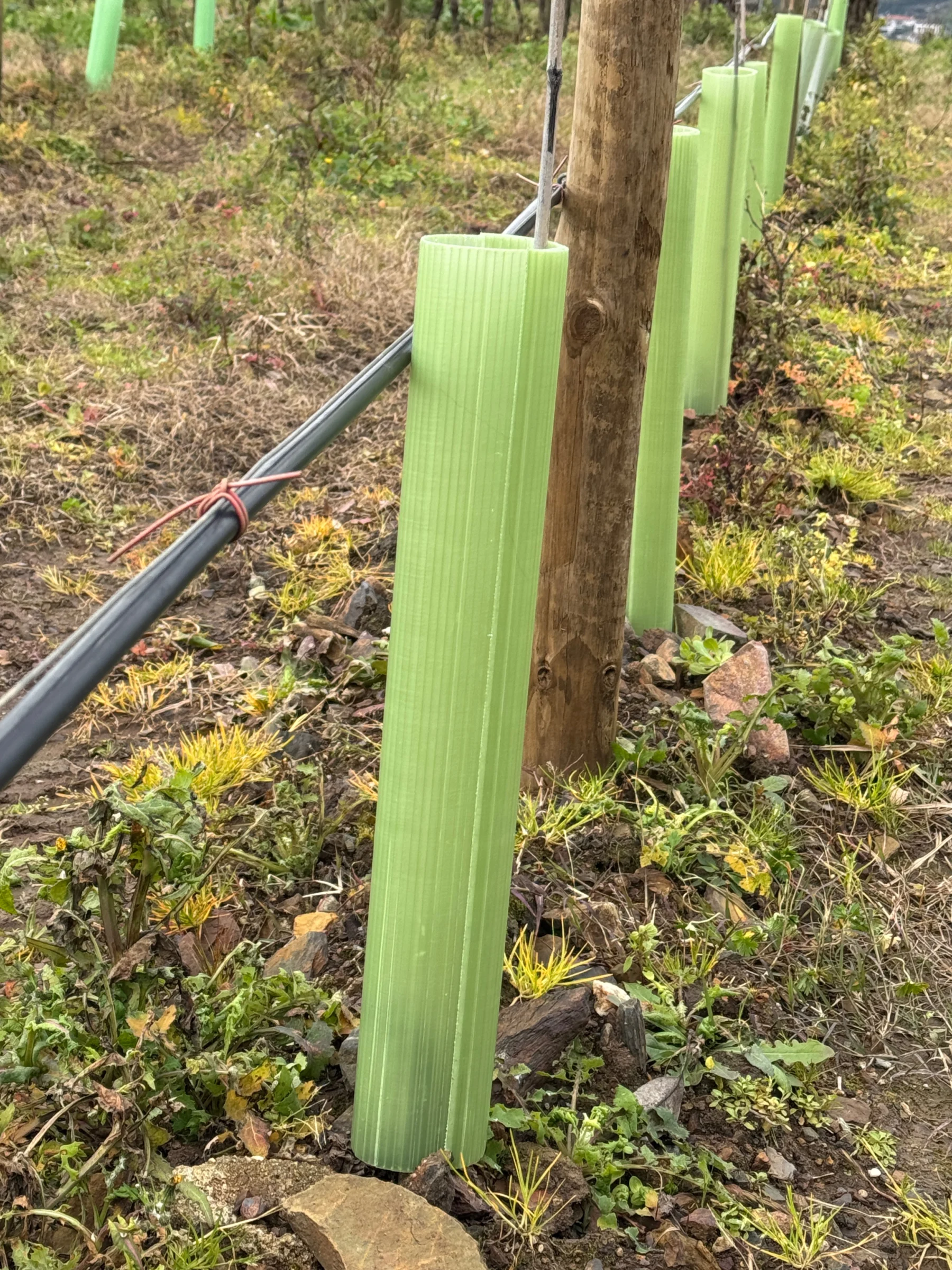
The specification differs from new planting in three ways. It needs to be tall enough to clear the working height of your machinery, not just tall enough to stop a rabbit. It needs to be visible from a tractor seat. And it needs to last the full catch-up period. A gapped-up vine may need three or four seasons to reach the fruiting wire that its neighbours are already on, which is longer than many growers assume when they order.
Ventilation matters more than it does on a new block, too. A replacement vine under an established canopy already has reduced airflow and higher humidity around the base. A guard that traps moisture on top of that invites disease pressure precisely where the plant is weakest. Our vine guards are designed around that balance: shelter from spray and mechanical damage without creating a stagnant microclimate.
Rodents, rabbits and the winter gap
Replants are also disproportionately vulnerable to browsing. A single young vine among mature plants is the most palatable thing in the row, and rabbit and vole pressure concentrates on it. Where vole activity is known, a guard alone may not be enough at ground level, and voleguards address the bark stripping that happens under snow and long grass over winter, when nobody is walking the rows to notice.
Planning the 2027 replant now
Post-harvest is the right moment to audit. Walk the blocks while you can still see which vines carried fruit and which did not, and mark the gaps before winter pruning erases the evidence. Count properly, because growers routinely underestimate gap numbers by a wide margin, then order short and leave half the job for the following year, which compounds the age gap in the row.
Then decide whether you are gapping up or replanting whole. Below roughly 10% loss in a block, gapping up is usually right. Above 20%, and particularly where losses cluster rather than scatter, replanting the block gives you a uniform row that is easier to manage for the next two decades, and lets you reconsider variety and rootstock in light of how the last few seasons actually went. For background on sector conditions and vintage reporting, Vineyard Magazine tracks the season in detail.
Whichever route you take, order protection at the same time as the plants rather than after them. Replacement vines that sit unguarded for their first season are the ones you will be replacing again. Our viticulture pages cover specification by site type, and our distributors can quote for replant quantities.