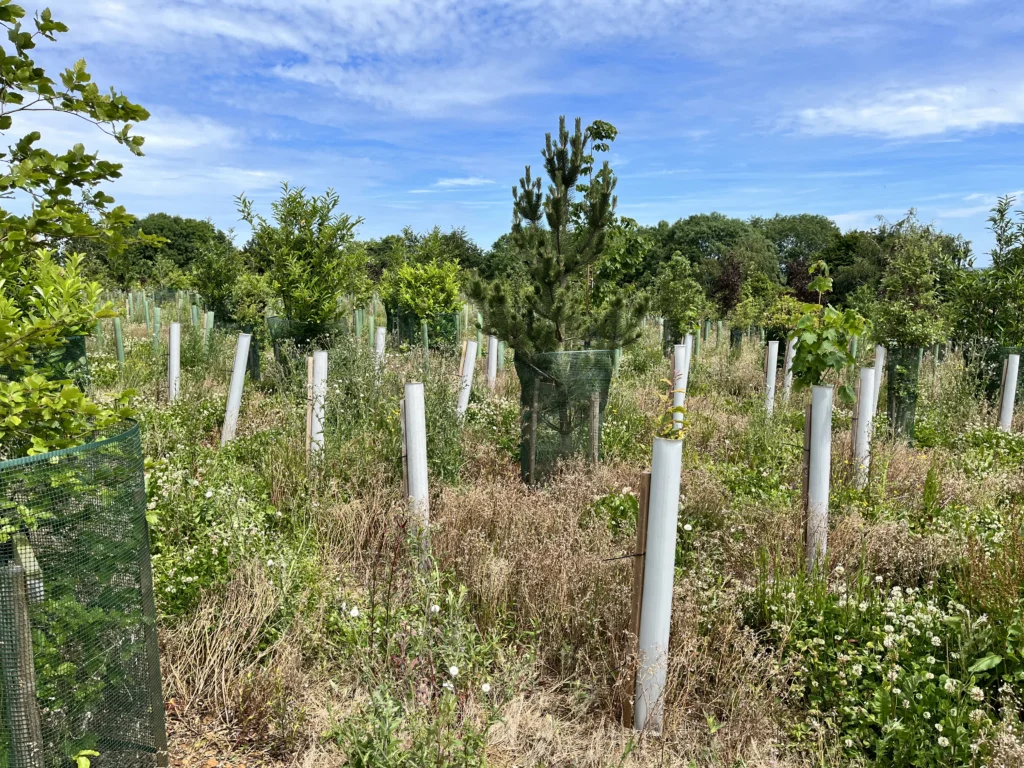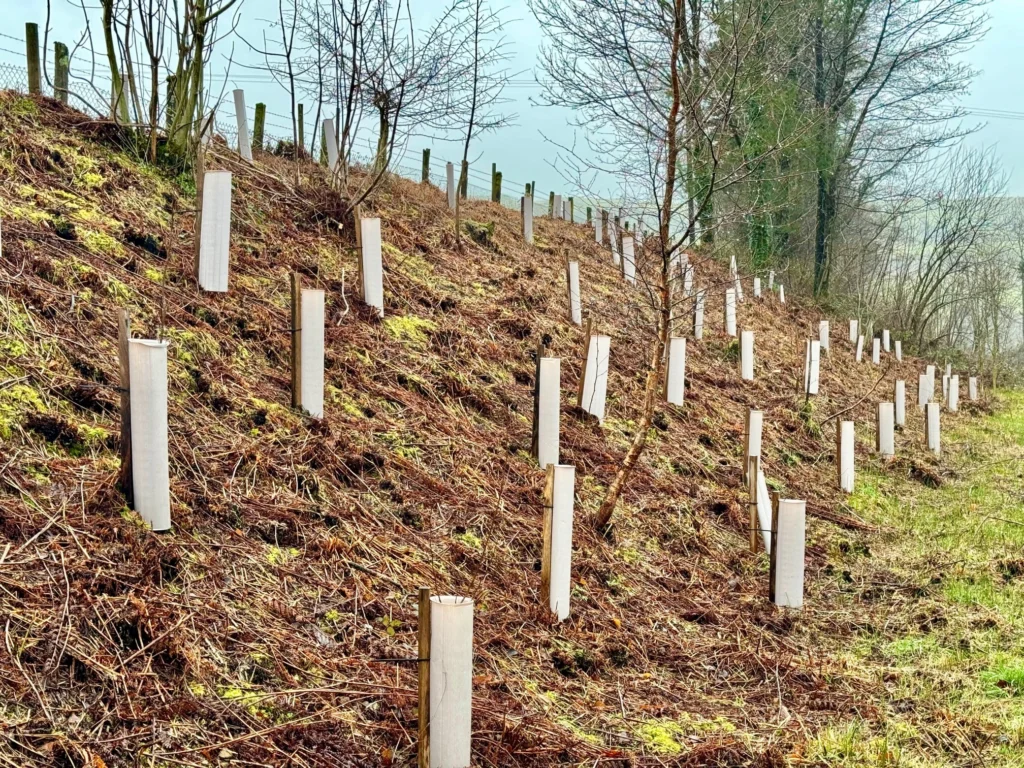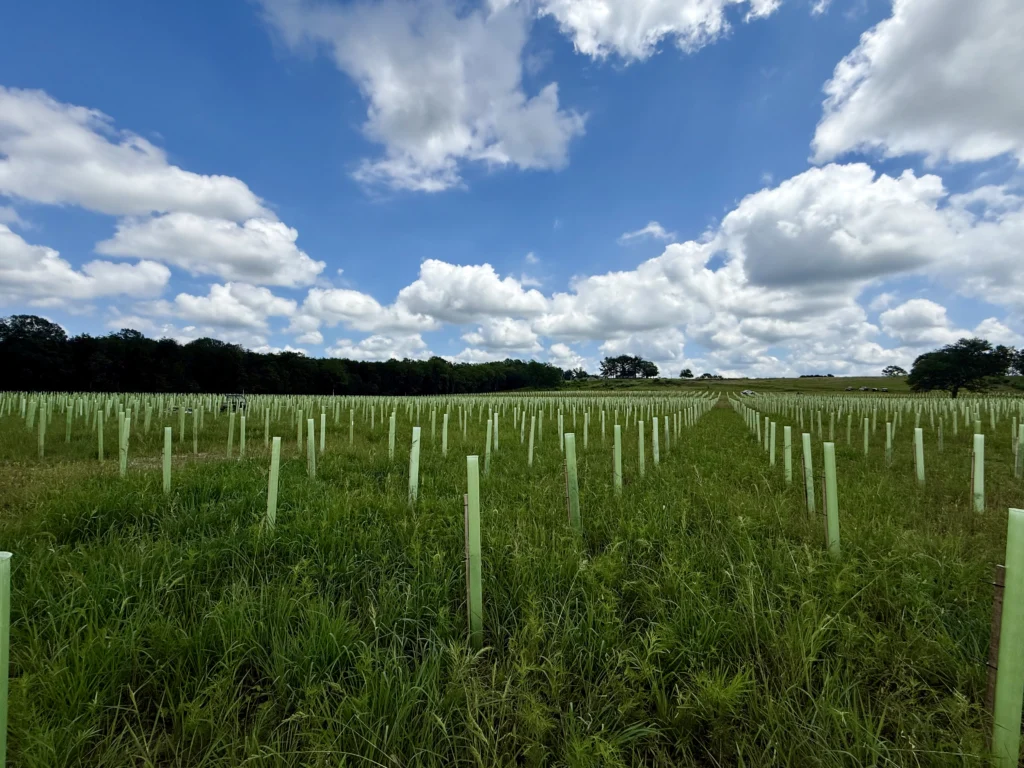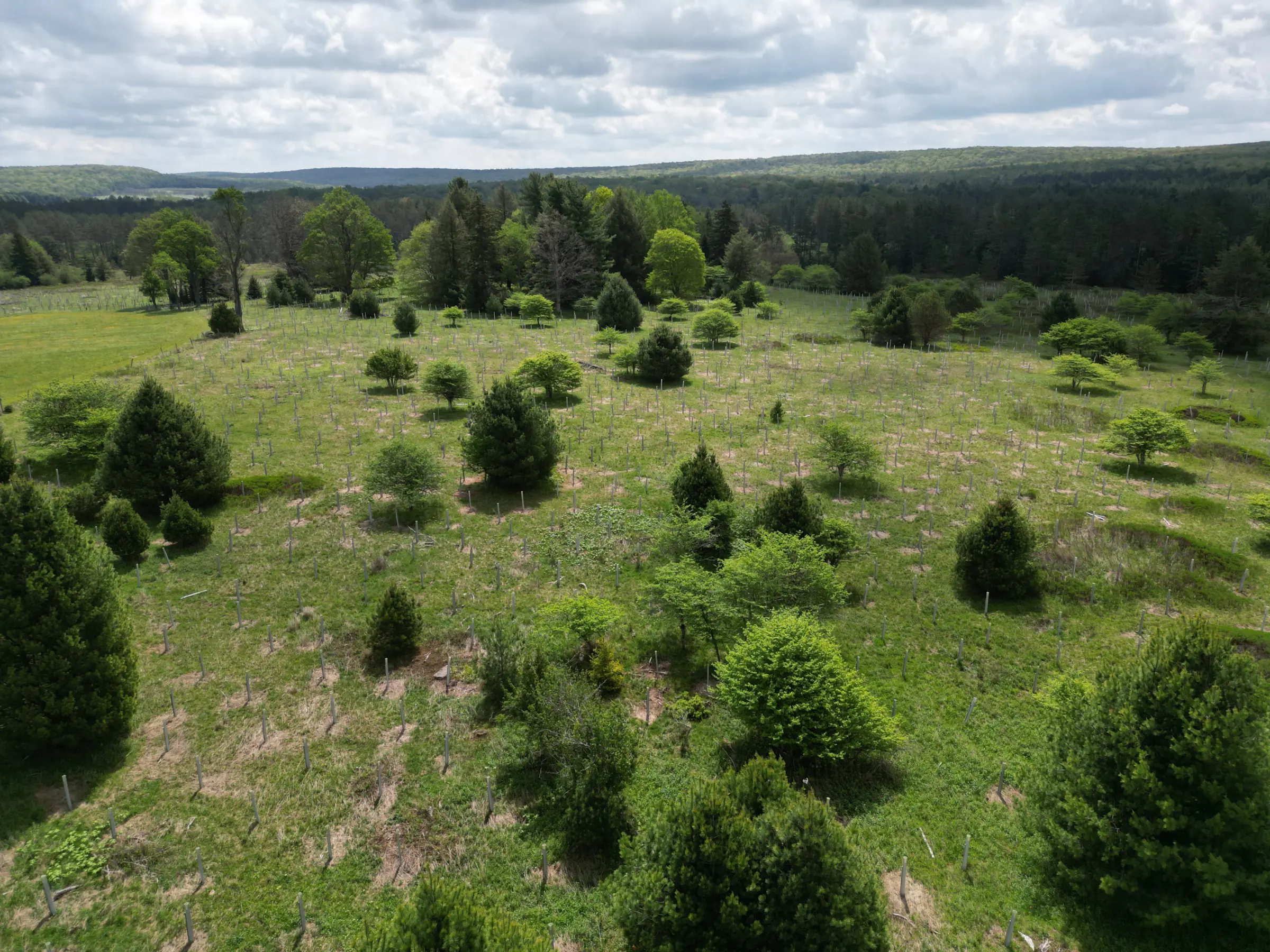
For conservation projects planting tens of thousands of trees, the question of which shelter to specify is no longer just “what will protect the tree?”. It is also “what do we leave behind?” The decision between Vigilis Bio vs standard tree shelters comes down to how a project balances up-front cost, end-of-life management and long-term site condition. This guide compares the two on the criteria that matter for conservation work, and outlines where each is the right fit.
What “standard” means in this comparison
By “standard” we mean a traditional polypropylene tree shelter, the rigid twin-wall plastic tube that has dominated UK and European planting for three decades. Polypropylene shelters are time-tested, predictable in performance and generally lower in up-front cost. Their downside is at end-of-life: once the tree is established, the shelter must be retrieved, sorted and either recycled or disposed of. On a project of any scale, that retrieval visit is a real labour cost, and the longer the shelter sits in the field after its job is done, the more it fragments into microplastics that stay in the soil.
What Vigilis Bio brings to the table
The Vigilis Bio shelter is a soil-biodegradable alternative engineered to perform like a conventional shelter for five years, then biodegrade in situ. The material is tested to OK Compost HOME (TÜV Austria), is free of BPA and PFAS, and degrades to water, minerals and CO₂, no microplastic residue. Five years of UK field data, across 70 monitored sites, confirm the shelter holds mechanical strength through the establishment period and then breaks down cleanly once that job is done.
Vigilis Bio vs standard tree shelters: side-by-side
Both shelters protect a tree well during establishment. They differ on what happens afterwards, and on how each fits into a project’s reporting and budget. The criteria below summarise the trade-offs for a conservation planting:
- Up-front cost. Standard polypropylene shelters are typically lower per unit. Vigilis Bio costs slightly more up front, but eliminates retrieval labour at the other end.
- End-of-life management. Standard shelters require a retrieval visit; Vigilis Bio breaks down in the soil. For large or hard-to-reach plantings, the labour difference is significant.
- Microplastic legacy. Polypropylene fragments over time and leaves microplastics in the soil if not removed promptly. Vigilis Bio degrades to water, minerals and CO₂, no microplastic residue.
- Carbon footprint. Vigilis Bio has a 35% lower carbon footprint than equivalent polypropylene, per a third-party desktop LCA by Bangor University BioComposites Centre.
- Site visibility. Both ranges come in muted colours that blend with the landscape; Vigilis Bio additionally avoids the long-tail visual impact of broken shelters lingering on site.
- Browsing resistance. Equivalent for both: properly specified and installed shelters from either family deter rabbit, deer and vole pressure.
- ESG and project reporting. For projects reporting against environmental criteria, in-situ biodegradation simplifies the end-of-life narrative and removes a future liability from the books.
When standard shelters still make sense
Conventional polypropylene shelters remain the right call for many conservation projects. Short-rotation plantings where the shelter will be removed and reused, sites with retrieval logistics already in place, and projects with a strict per-unit cost ceiling are all cases where a standard shelter delivers good value. A polypropylene shelter that is properly retrieved and recycled keeps its environmental impact contained, provided the retrieval visit actually happens.
When Vigilis Bio is the better fit
Vigilis Bio comes into its own when retrieval is impractical or undesirable: large-scale plantings across hundreds of hectares, hard-to-access rewilding sites, multi-decade conservation projects where labour cost compounds, and any context reporting against zero-microplastic or biodiversity-positive targets. Ecological corridors, long-rotation hedgerow restoration and highway and infrastructure planting, where return visits to dispersed sites are expensive, are typical fits.
Choosing for your conservation project
The honest answer is that the right shelter depends on the project. Map your decision against three questions: will you retrieve the shelters, and at what cost? How does the project report on environmental impact? And what is your tolerance for residual material on site after the establishment phase? For a project-specific specification, find your local Vigilis distributor. They can quote both standard and Bio options against your tree numbers and lead time. More on the science behind Vigilis Bio if you want to take the material question further.