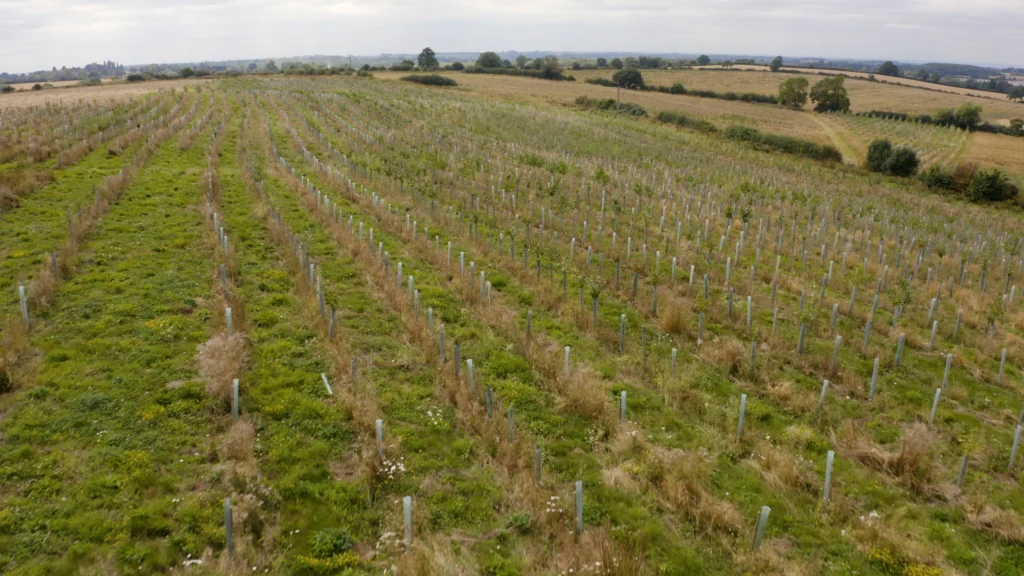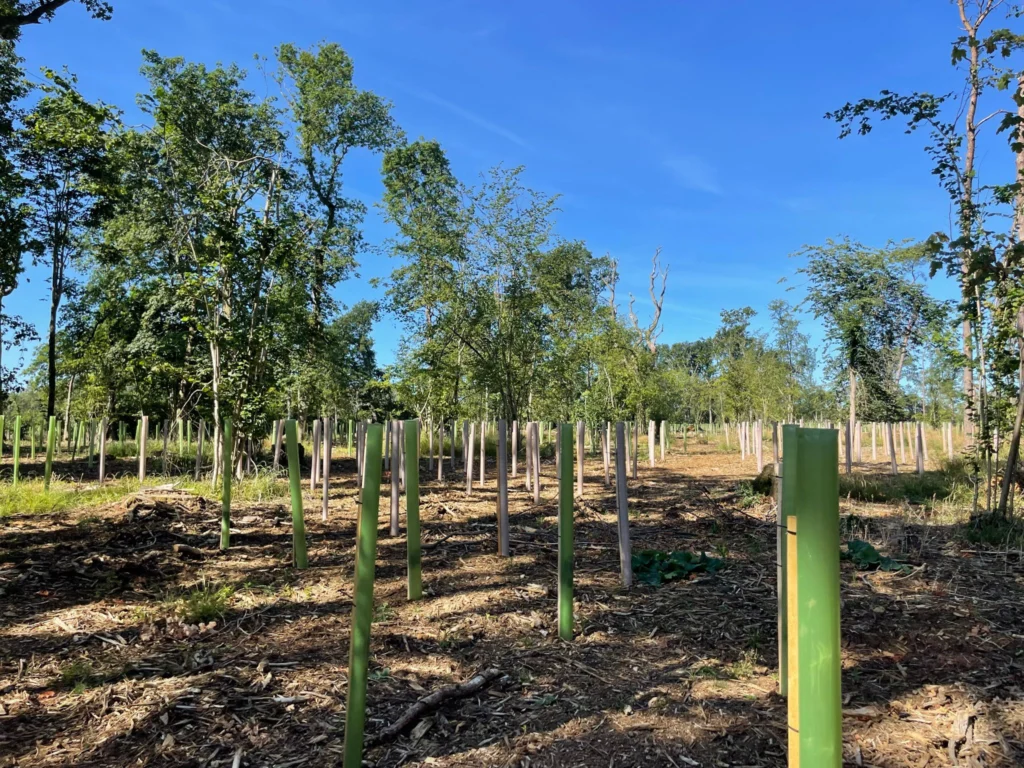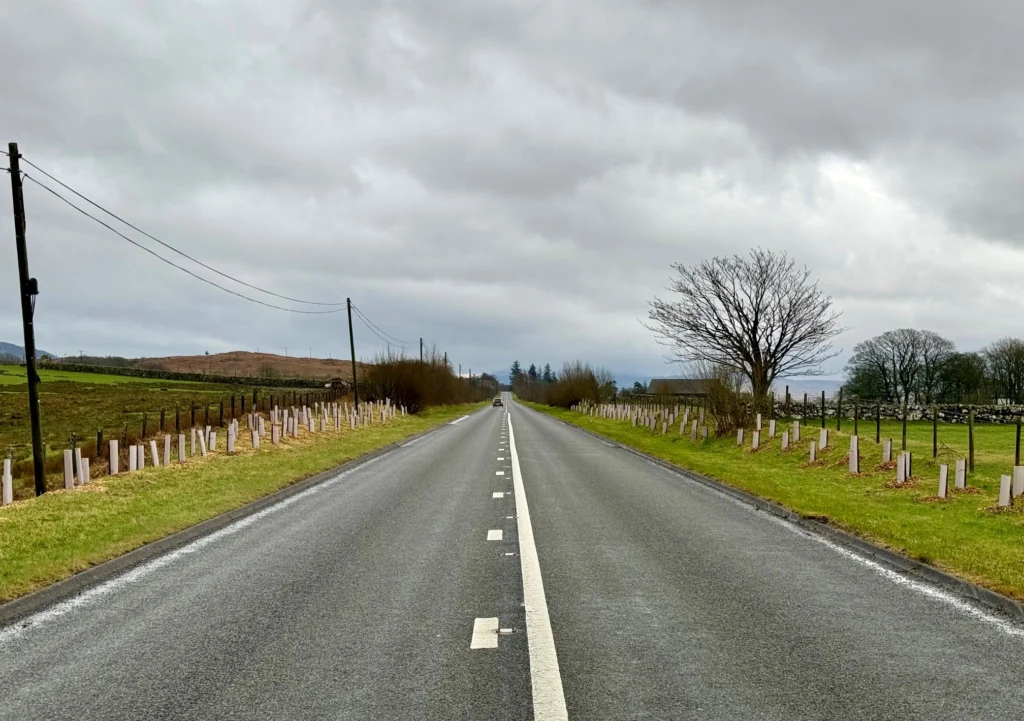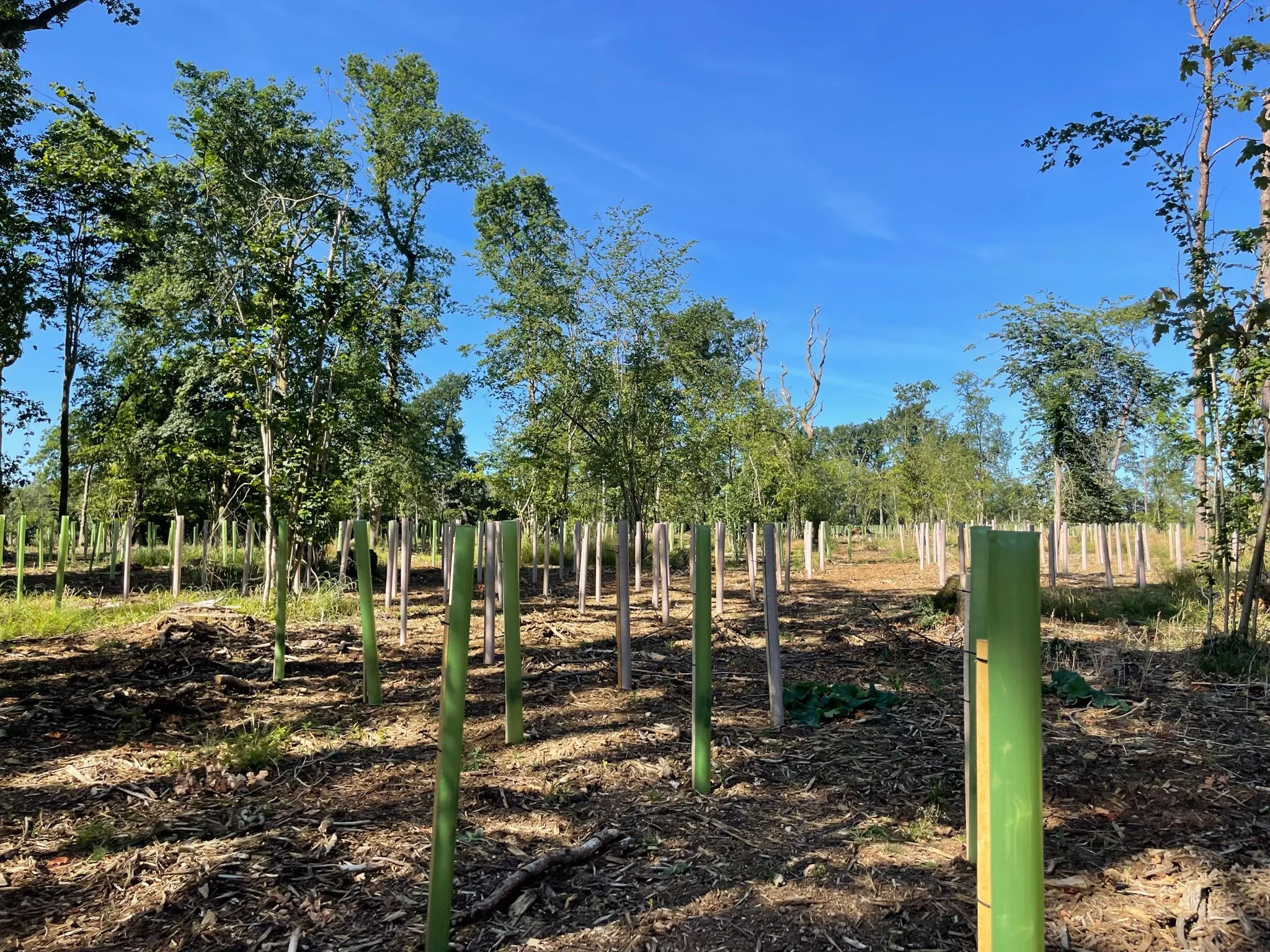
The pressure to move away from single-use plastic in forestry is growing. The Woodland Trust has committed to eliminating plastic tree guards from all its activities by 2030. Forest Research is actively publishing guidance on biodegradable alternatives. Local authority procurement teams are starting to ask the question before they place orders.
If you are specifying tree protection for a planting project (woodland creation, highway schemes, community planting or estate management), you will increasingly need to understand the difference between conventional plastic shelters and biodegradable alternatives. Not just for environmental reasons, but because the two products behave differently in the field.
How conventional plastic tree shelters work
Standard tree shelters are manufactured from polypropylene: a lightweight, UV-stabilised plastic that provides a rigid, protected microclimate for young trees during their establishment years. They are twin-walled for insulation and structural strength, and most are designed to be removed and recycled at the end of their working life, typically five to six years after planting.
The challenge is recovery. In practice, many plastic shelters are never collected. They fragment over time into smaller pieces that persist in the soil for decades. Large-scale planting programmes can leave thousands of shelters distributed across difficult-to-access land, making retrieval logistically and economically challenging.
Recyclable plastic shelters remain a practical and cost-effective option where retrieval is feasible and there is a clear plan to collect and recycle at end of life.
How biodegradable tree shelters work
Biodegradable tree shelters are manufactured from materials designed to break down naturally in soil after the shelter has served its protective purpose. The Vigilis Bio range, for example, is 100% soil-biodegradable and eco-toxicity neutral. Meaning the breakdown products do not harm soil health or the surrounding environment.
A soil-biodegradable shelter provides the same structural and microclimatic protection as a conventional plastic equivalent during the tree establishment period. After the tree outgrows the shelter, typically after five to six years, the shelter begins to degrade in the soil over a further two to three years, leaving no waste behind and requiring no retrieval operation.
It is worth noting the distinction between “biodegradable” and “soil-biodegradable.” Some products marketed as biodegradable require specific industrial composting conditions to break down. A soil-biodegradable product degrades in natural soil conditions without any intervention.
Plastic vs biodegradable: a practical comparison
| Factor | Conventional plastic | Soil-biodegradable |
|---|---|---|
| Protection performance | Proven, well-tested | Equivalent to plastic |
| Lifespan | 5–6 years | 5–6 years, then degrades |
| End-of-life retrieval | Required, must be collected and recycled | Not required, breaks down in soil |
| Environmental residue | Fragments if not retrieved | None: eco-toxicity neutral |
| Procurement compliance | Requires retrieval plan | Meets Woodland Trust and similar requirements |
| Cost | Lower unit cost | Comparable, slightly higher |
| Best for | Accessible sites with retrieval plans | Remote sites, large schemes, sustainability requirements |
The procurement and policy context
The Woodland Trust’s 2030 plastic-free commitment has already begun to influence how large forestry and conservation organisations specify tree protection. Forest Research’s ongoing work into biodegradable alternatives is building the evidence base for wider adoption across the sector.
For local authorities, estate managers, and organisations with published sustainability commitments, biodegradable tree shelters increasingly represent the lower-risk specification, one that avoids future retrieval obligations and aligns with environmental procurement policies.
Which should you specify?
The honest answer is: it depends on your site and your project requirements.
If you are planting on accessible land, have a clear end-of-life retrieval plan, and are working to a tight budget, conventional recyclable shelters remain a sound choice.
If you are planting at scale, in difficult-to-access locations, or working to sustainability criteria that restrict single-use plastic, a soil-biodegradable shelter removes the retrieval burden and provides equivalent protection throughout the tree’s establishment phase.
Vigilis manufactures both. Our Standard range is manufactured from UV-stabilised, recyclable polypropylene. Our Bio range and Bio VentAir range are 100% soil-biodegradable. If you need increased airflow for specific species or site conditions, the VentAir range is also available in biodegradable form.
If you are unsure which to specify for your project, get in touch. We can advise based on your site, species mix, and sustainability requirements.