This woodland creation case study follows a two-phase planting at a stud farm in Oxfordshire, designed and managed by Nicholsons, the Oxfordshire-based forestry, plants and landscapes practice. Across two blocks totalling roughly 2.2 hectares, the project combines a 3,350-tree native broadleaf planting with something rarer: one of the original trial plots from Vigilis Bio’s 70-site UK field programme, now past its fifth year in the ground.
The site and the brief
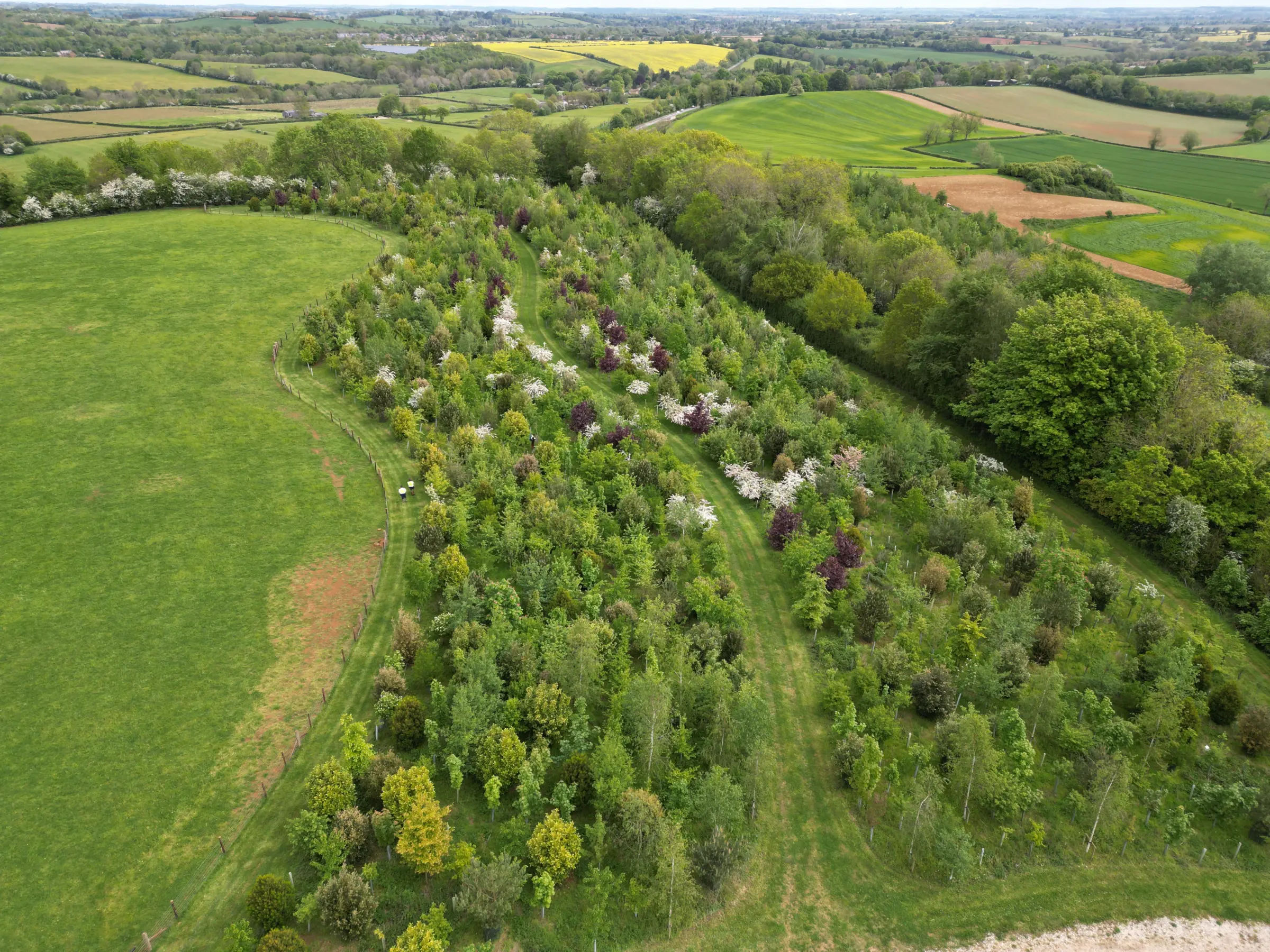
The planting sits in two sections: a northern block of around 1.57 hectares and a southern block of around 0.66 hectares, either side of existing pasture. The client’s brief to Nicholsons was a permanent, resilient native woodland: amenity and landscape value first, with the structure and species diversity to stand on its own once established.
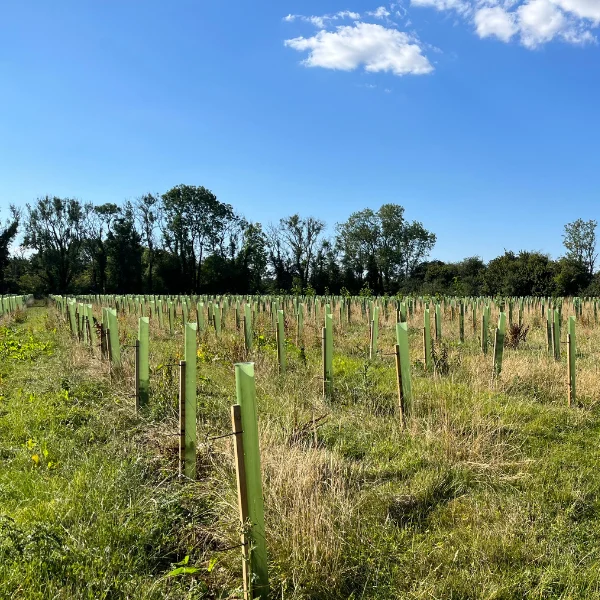
Woodland manager Dai Lewis, Associate Director and Principal Woodland Manager at Nicholsons, specified a classic establishment design: bare-root native whips of 40–60 cm planted at 2.0 metre centres (2,500 stems per hectare), with larger containerised specimen trees staked through the matrix for early structure.
A species mix built for resilience
The main planting, carried out in February 2023, ran to 3,350 whips across fifteen native species, a deliberately broad mix that spreads disease and climate risk rather than concentrating it:
- English oak (Quercus robur): 400 trees, the largest single share at 12%
- Sycamore and alder: 350 each
- Norway maple, silver birch and wild cherry: 250 each
- Dogwood, hazel, hawthorn, spindle, willow and small-leaved lime: 200 each, forming the shrub and understorey layer
- Crab apple, aspen and wild service tree: 100 each, the low-frequency diversity species
No species exceeds 12% of the total, the kind of mix that ash dieback taught UK forestry to value.
Protection: standard shelters, plus a biodegradable trial block
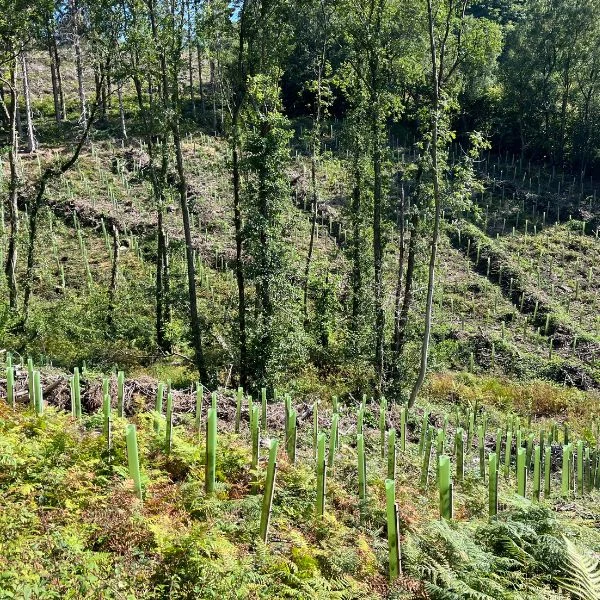
Browsing pressure on the site is typical for rural Oxfordshire, rabbit and deer both present, so every whip went into a shelter. The main 2023 planting was protected with standard recyclable Vigilis tree guards on stakes, giving each tree herbivore protection, a sheltered microclimate and a visible marker for maintenance visits.
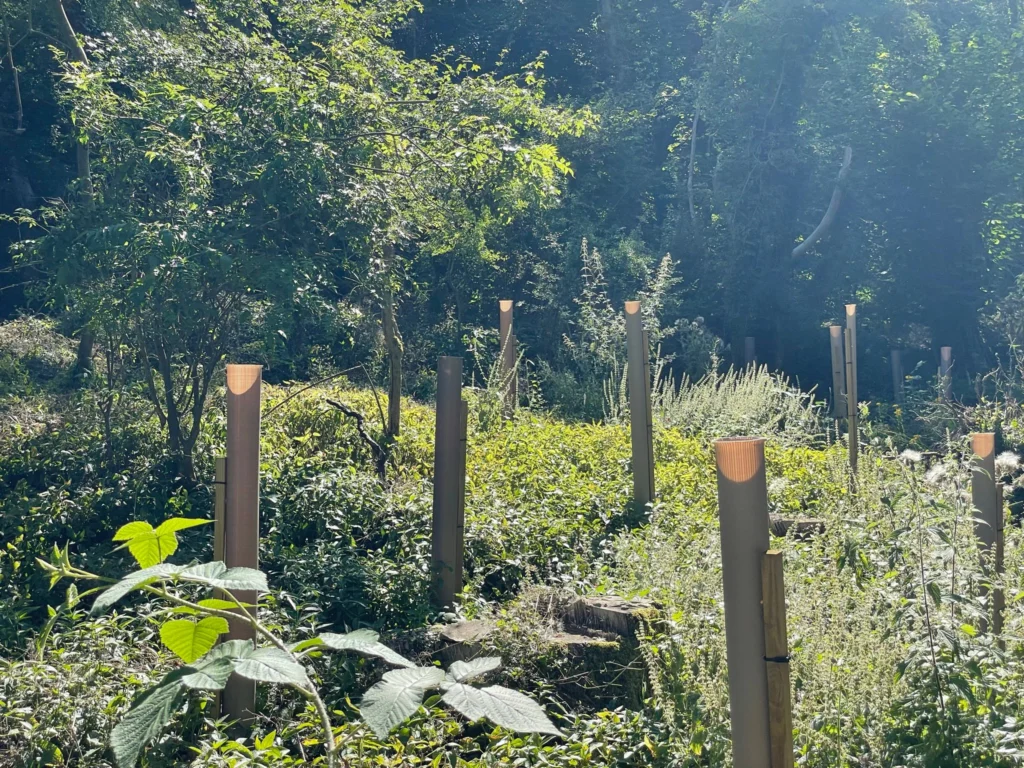
The northern block, though, already held something older. In January 2021, a trial plot of Vigilis Bio soil-biodegradable shelters was planted here as part of the 70-site UK Phase 2 monitoring programme, the field trial that runs from the Hebrides to Cornwall and underpins the product’s biodegradability data.
Five years on: how the trial block is performing
In May 2026, Vigilis walked the trial planting with Dai Lewis, five years and a full establishment period after planting. The findings, covered in detail in our five-year trial report: survival is very high, growth is strong, and the shelters, now past their five-year functional life, are going brittle, breaking away from the trees and fragmenting into the leaf litter exactly as designed.
“Not only do Vigilis shelters perform their primary function of protecting trees for planting projects, the shelters are also manufactured from materials which break down naturally in the soil, so they don’t have to be removed or recycled, making them a great choice for highway schemes, community planting or estate management.”
Dai Lewis, Nicholsons
What this woodland creation case study shows
For land managers planning similar work, three things stand out. A diverse native mix at standard 2.0 m spacing remains the most resilient template for small-scale woodland creation. Shelter specification belongs in the order paperwork from the start, it changes the planting numbers themselves. And on sites where retrieval is impractical or unwanted, the five-year evidence from this estate shows soil-biodegradable protection doing both halves of its job: protect first, then disappear.
For protection specification on your own woodland creation project, see our forestry applications page or find your local Vigilis distributor.